
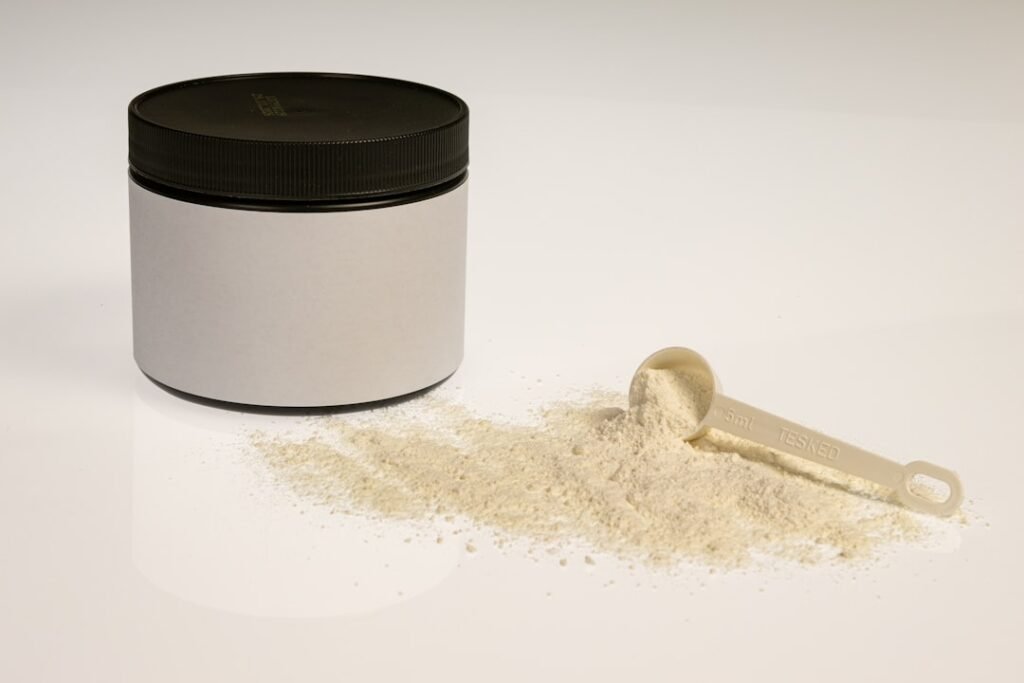
Collagen supplements increasingly come with labels such as marine collagen, bovine collagen, Type I, Type II, Type III and multi-collagen.
It can make choosing a product unnecessarily confusing.
The first thing to understand is that a collagen source and a collagen type are not the same thing.
Marine, bovine and chicken tell you where the collagen ingredient comes from. Types I, II and III describe different forms of collagen found naturally in animal and human tissues.
And importantly, seeing more collagen types on a label does not automatically mean a supplement is better.
Here is what the differences actually mean.
Marine, bovine and chicken collagen at a glance
| Source | Usually derived from | Common collagen association | Important consideration |
|---|---|---|---|
| Marine collagen | Fish skin and scales | Predominantly Type I | Fish allergen |
| Bovine collagen | Cattle hide/bone | Types I and III | Source and certification matter |
| Chicken collagen | Chicken cartilage, especially sternum | Type II | Hydrolysed and native forms are different |
Scientific reviews generally associate bovine collagen with Types I and III, marine collagen predominantly with Type I, and chicken cartilage with Type II. However, the exact composition ultimately depends on the raw material and manufacturing process. A responsible manufacturer should rely on its ingredient specification rather than simply assuming a collagen type from the animal source.
What is hydrolysed collagen?
Most collagen powders are sold as hydrolysed collagen or collagen peptides.
Natural collagen molecules are large proteins. Hydrolysis uses controlled processing to break them into smaller peptides that disperse more easily and can be digested and absorbed.
This is an important distinction because once collagen has been extensively hydrolysed, you are consuming collagen-derived peptides, rather than intact Type I or Type III fibres travelling directly to your skin or joints.
Your digestive system processes those peptides and amino acids before the body uses them.
A 2024 randomised crossover study comparing fish, bovine and porcine collagen hydrolysates found meaningful absorption from all of them, with no clear basis for assuming that marine collagen automatically has a major absorption advantage simply because it comes from fish.
What is marine collagen?
Marine collagen is normally produced from fish-processing materials such as skin and scales.
It is particularly associated with Type I collagen, which is an important structural collagen found throughout the human body.
Marine collagen has become especially popular in beauty and wellness products. It is also an alternative for people who consume fish but prefer to avoid bovine-derived ingredients.
There is, however, an important allergen consideration.
Fish is one of the 14 allergens that must be declared under UK food-labelling rules. A fish-derived collagen ingredient therefore needs appropriate allergen labelling.
Marine collagen is not vegan or vegetarian.
What is bovine collagen?
Bovine collagen generally comes from cattle hides and other collagen-rich bovine tissues.
Bovine collagen ingredients are commonly associated with Types I and III.
It is one of the most widely available collagen sources and is particularly suitable for producing high-dose collagen peptide powders because it can be manufactured economically at scale.
Consumers with religious or dietary requirements should look beyond the word “bovine”.
For example, someone seeking halal bovine collagen should check whether the actual collagen supply chain and ingredient carry appropriate halal certification rather than assuming that all bovine collagen is halal.
What is chicken collagen?
Chicken collagen is different.
Chicken sternum and other cartilage tissues are important sources of Type II collagen, which is strongly associated with cartilage.
There is another distinction consumers should understand:
hydrolysed chicken collagen and native or undenatured Type II collagen are not interchangeable ingredients.
Hydrolysed chicken cartilage can be incorporated into collagen peptide powders at relatively substantial doses.
Native or undenatured Type II collagen, on the other hand, is used in much smaller amounts in some specialised supplements and has been studied separately. Clinical studies of particular native Type II ingredients have commonly used doses measured in milligrams rather than grams.
So two products that both say “chicken collagen” can actually be very different formulations.
Is marine collagen better than bovine collagen?
There is no convincing basis for saying that one is universally better.
Marine and bovine collagen differ in source and typical collagen profile, but source alone does not determine the quality of the finished supplement.
Factors such as these may matter just as much:
dose, degree of hydrolysis, peptide specification, protein content, contaminants, taste, solubility, manufacturing controls and the consumer’s dietary requirements.
Marine collagen may make sense for someone preferring a fish-derived product.
Bovine may make more sense for someone looking for an economical, high-dose collagen powder.
Neither choice is automatically superior.
What about multi-source collagen?
This is where collagen products become particularly interesting.
A multi-source formulation can combine, for example:
bovine collagen + marine collagen + chicken cartilage collagen.
That can provide ingredients originating from sources commonly associated with Types I, II and III.
But there is an important distinction between:
“contains several collagen sources”
and
“clinically proven to be superior because it contains several collagen types.”
Those are not the same statement.
At present, there is not strong evidence showing that simply combining three animal sources makes a supplement inherently more effective than a well-formulated single-source collagen product.
A multi-source formula can nevertheless offer a genuinely different ingredient profile and may suit consumers specifically looking for several collagen sources in one product.
Quality, dose and ingredient specifications still matter.
Does oral collagen actually work?
The scientific evidence is more nuanced than many supplement adverts suggest.
Several systematic reviews have reported improvements in measures such as skin hydration and elasticity following oral collagen supplementation.
However, recent reviews also highlight substantial variation between studies, short follow-up periods, incomplete reporting and frequent industry involvement.
So the responsible interpretation is:
collagen supplementation has promising evidence in some areas, but the evidence is not strong enough to justify exaggerated promises.
That is also why it is useful to distinguish ingredient science from marketing claims.
What about vitamin C?
Vitamin C plays an established role in normal collagen formation.
In Great Britain, there is an authorised health claim that vitamin C contributes to normal collagen formation for the normal function of skin, provided the product meets the conditions for use of the claim.
That is very different from claiming that a supplement treats wrinkles, repairs damaged joints or cures a medical condition.
UK rules prohibit foods and supplements from claiming or implying that they prevent, treat or cure disease.
Which collagen should you choose?
For most people, the sensible question is not simply “which collagen is best?”
It is:
What source do I prefer, what does the product actually contain, and is the formulation clearly specified?
Marine collagen provides a fish-derived option predominantly associated with Type I.
Bovine collagen commonly provides Types I and III and works well for high-dose collagen peptide products.
Chicken cartilage offers access to Type II-rich ingredients and can be used alongside other sources in multi-collagen formulations.
None of these automatically makes a product superior.
Look at the actual serving size, source, collagen specification, additional ingredients, allergen information and manufacturing quality rather than judging a product by the number of collagen types printed on the front.
The TEEKIJAY approach
At TEEKIJAY, we believe supplement information should be clear enough to compare without exaggerated promises.
As our collagen range develops, we will continue explaining the differences between sources, formulations and formats in our Journal so consumers can make informed choices. You can also explore the wider TEEKIJAY shop as new products are introduced.
Frequently asked questions
Is marine collagen better than bovine collagen?
Not necessarily. Marine collagen is predominantly associated with Type I, while bovine collagen commonly contains Types I and III. The better choice depends on source preference, formulation, dose, quality and dietary considerations.
Which collagen contains Type II?
Chicken cartilage, particularly sternum cartilage, is a common source of Type II collagen.
Can marine and bovine collagen be taken together?
They can be incorporated into the same food-supplement formulation. A multi-source product should clearly identify its ingredients and applicable allergens.
Does marine collagen absorb better than bovine collagen?
There is not strong evidence that marine collagen is universally better absorbed. Human studies show relevant uptake from both fish and bovine collagen hydrolysates.
Is marine collagen suitable for someone with a fish allergy?
Marine collagen is fish-derived, and fish is a regulated allergen in the UK. Someone with a fish allergy should not assume marine collagen is suitable.